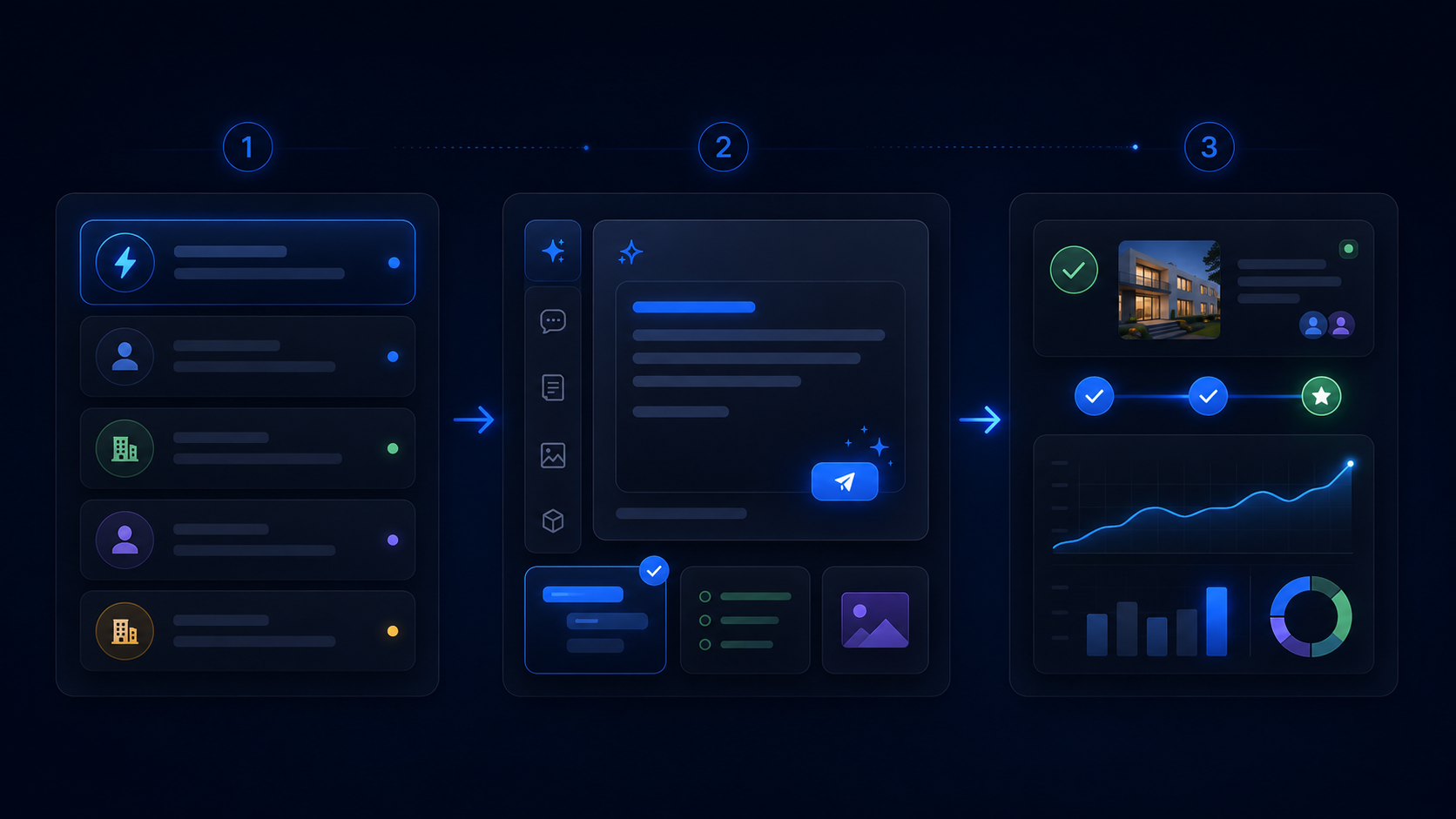
Conversion Realtor reads the signals inside lead conversations — including intent, urgency, timing, objections, sentiment, engagement, and buyer or seller psychology — and turns them into a prioritized action plan. Instead of opening your CRM and wondering where to begin, you see the leads that matter now, the recommended next action, and personalized messaging you can review and send.
Your CRM stores the conversation. Conversion Realtor helps you decide what to do next.
Why traditional real estate follow-up systems fall short
Most agents do not lose leads because they never follow up. They lose leads because follow-up becomes inconsistent, generic, mistimed, or disconnected from what the prospect already said. A new internet lead may receive an immediate automated response, but what happens afterward?
- The agent has dozens of leads and no reliable way to prioritize them.
- Every prospect enters a similar drip campaign regardless of motivation or timeline.
- Important objections remain buried in notes and message history.
- Follow-up tasks are completed because they are due, not because the timing is right.
- Messages sound polished but fail to reflect the buyer's or seller's actual concerns.
- Leads go cold while the agent is busy with showings, contracts, and active clients.
Traditional CRMs are valuable systems of record. They capture contacts, organize conversations, track stages, and create tasks. But storing the information is not the same as interpreting it — a distinction we cover in detail in CRM versus conversion intelligence. Response timing matters too: our speed-to-lead research looks at how quickly agents reach new inquiries and what happens when they do not.
What is a real estate lead follow-up system?
A real estate lead follow-up system is the process and technology an agent uses to capture inquiries, organize prospects, prioritize opportunities, plan outreach, track conversations, and continue nurturing buyers and sellers until they are ready to move. An effective system should provide five things:
- 1Speed: New inquiries are acknowledged quickly.
- 2Context: Previous messages, preferences, concerns, and timelines remain accessible.
- 3Prioritization: The agent knows which leads require attention first.
- 4Relevance: Every follow-up reflects the person's situation and stage.
- 5Consistency: Promising opportunities do not disappear when the agent gets busy.
Many platforms handle the first two well. Conversion Realtor is designed to strengthen the other three by adding decision intelligence to the conversations you already have.
How Conversion Realtor improves real estate lead follow-up
1.It analyzes the conversation, not just the contact record
Two leads can come from the same source, ask about similar homes, and still need completely different approaches. One may be relocating within 30 days and worried about financing. Another may be casually comparing neighborhoods before a move next year. A third may have completed a showing but become hesitant after discussing monthly payments.
Conversion Realtor evaluates the language and context inside each conversation to identify signals such as:
- Buying or selling intent
- Urgency and expected timeline
- Questions and unresolved objections
- Positive or negative sentiment
- Financing friction
- Engagement changes
- Buyer or seller decision drivers
- Current stage in the relationship
The result is a Lead Intelligence Report that helps the agent understand what is happening beneath the surface — not simply when the last message was sent.
2.It ranks the leads that deserve attention now
A task list tells you what is scheduled. A conversion-intelligence system helps determine what is important. Conversion Realtor continuously prioritizes leads according to their current signals, opportunity, timing, and risk, so agents begin the day with a ranked action queue instead of reviewing every record manually.
That distinction matters because the oldest task is not always the best opportunity. A recent change in tone, a new question, a post-showing concern, or a newly clarified timeline can make another lead more urgent.
3.It recommends the next best move
After identifying the most important leads, Conversion Realtor recommends an appropriate next action. Depending on the situation, that could include:
- Responding immediately
- Calling to clarify a high-intent question
- Sending a low-friction text
- Sharing useful information by email
- Following up after a showing
- Addressing an objection before asking for an appointment
- Pausing outreach to avoid communication fatigue
- Moving the lead into longer-term nurture
Each recommendation includes the timing, suggested channel, call to action, and an explanation of why the move fits the lead's current situation.
4.It creates personalized, ready-to-send messaging
Generic AI can produce a well-written message. Conversion Realtor uses the lead's conversation, persona, stage, timing, and relevant signals to produce a message aligned with the recommended action. The objective is not to make every message longer or more persuasive. It is to make the message more appropriate.
Agents can review and personalize the suggested message before sending, preserving human judgment while reducing the time and mental effort required to decide what to write.
5.It uses guardrails to prevent bad follow-up
More follow-up is not always better. An effective system must recognize when a message could be repetitive, premature, insensitive, or disconnected from the conversation. Conversion Realtor uses decision guardrails that account for conditions such as:
- Negative sentiment
- Recent post-showing communication
- Changes in the lead's stated timeline
- Excessive recent contact attempts
- Financing obstacles
- Appointment status
- Pauses or requests for space
- Closed, lost, or disqualified stages
These guardrails help prevent automation from continuing blindly after the situation has changed.
Messaging changes with the person on the other side of the conversation. See how the approach differs for a first-time buyer, a luxury buyer, an investor, a growing family, an empty nester, or a seller through seller persona intelligence.
Stop Guessing What to Do Next
See how Conversion Realtor turns a lead conversation into a prioritized, explainable next action.
Analyze My Lead FreeA smarter follow-up cadence for real estate leads
Fixed follow-up plans can provide structure, but cadence should never replace context. A new high-intent inquiry may require immediate attention, while a long-term buyer may benefit from occasional, useful guidance. A practical starting framework is:
- Immediately: Acknowledge the inquiry and respond to the specific request.
- First day: Attempt personal contact through an appropriate channel and offer one clear next step.
- First week: Maintain momentum while varying the purpose of each touchpoint.
- Following weeks: Adjust frequency according to replies, activity, timeline, and stage.
- Long-term nurture: Provide relevant value around milestones, market changes, preparation, or stated goals.
Conversion Realtor improves this framework by evaluating what has changed. If a lead replies, schedules an appointment, completes a showing, raises an objection, changes their timeline, or stops engaging, the recommended follow-up changes with them. The behavioral science behind real estate decisions explains why that responsiveness matters more than frequency.
Real estate follow-up examples
New buyer inquiry
Instead of
Are you still interested in this property?
Context-aware alternative
Hi Jordan, I saw your question about the home on Oak Street. Are you mainly trying to confirm the monthly payment, or would it be more helpful to see similar homes in the same price range?
Seller valuation request
Instead of
When can we schedule a listing appointment?
Context-aware alternative
Hi Taylor, thanks for requesting information about your home. Online estimates are a useful starting point, but condition, updates, and recent nearby sales can change the number. Are you considering a move soon, or are you beginning to explore your options?
Post-showing hesitation
Instead of
Here are a few more listings to look at.
Context-aware alternative
Thanks again for touring the home. It sounded like the layout worked, but the monthly cost may be the bigger concern. Would it help if I sent two similar options with a lower estimated payment?
The strongest message is not necessarily the most aggressive one. It is the message that demonstrates that the agent listened and understands the next decision the person is trying to make. That principle sits at the center of real estate lead conversion.
Use multiple channels without creating more noise
Different conversations require different channels:
Phone
High-intent questions, complex decisions, negotiation, and appointment setting
Text
Quick questions, confirmations, short updates, and low-friction replies
Property options, documents, market context, and detailed guidance
Video
Personal explanations, listing insights, and relationship-building
Using several channels does not mean repeating the same message everywhere. Each interaction should move the conversation forward or make the next response easier. Conversion Realtor recommends a channel as part of its next-best-action guidance, helping the agent choose outreach according to context rather than habit alone.
Metrics that reveal whether follow-up is working
Lead volume does not tell you whether your follow-up system is effective. Track the movement that happens after the lead arrives:
- Speed to first response: How quickly new inquiries receive a meaningful reply
- Contact rate: How many leads enter a two-way conversation
- Appointment rate: How many conversations become consultations, showings, or listing appointments
- Stage aging: How long leads remain inactive without a meaningful next step
- Lead-source conversion: Which sources produce conversations and appointments — not only form submissions
- Re-engagement rate: How often dormant prospects return to an active conversation
- Outcome rate: Which recommended actions contribute to progression, nurture, or closure
These metrics help separate a lead-quality problem from a response, messaging, prioritization, or process problem.
How Conversion Realtor works with your CRM
Conversion Realtor is not designed to force agents to abandon the CRM they already use. It functions as a conversion-intelligence layer that helps interpret the conversations and lead data stored within that workflow.
With the Follow Up Boss integration, lead intelligence can support notes, tasks, and recommendations inside an agent's existing process. The CRM remains the system of record; Conversion Realtor becomes the decision layer that helps turn that record into action.
This allows teams to improve follow-up without rebuilding their entire technology stack or asking agents to manage another disconnected database.
A simple daily real estate follow-up workflow
- 1Review the ranked action queue. Start with leads showing the strongest combination of intent, urgency, opportunity, and risk.
- 2Open the lead's intelligence report. Understand the signals, objections, stage, and reason behind the recommendation.
- 3Review the next best action. Confirm the timing, channel, and objective.
- 4Personalize the suggested message. Add any local or relationship-specific detail the system could not know.
- 5Complete the outreach. Record the outcome and any new information.
- 6Let the recommendation update. As the lead changes, the next move and priority can change with them.
This turns follow-up from a mood-based activity into a repeatable decision process while keeping the agent at the center of the relationship.
Who is Conversion Realtor built for?
- Solo agents managing internet buyer and seller leads
- Real estate teams that need more consistent follow-up across multiple agents
- Brokerages seeking greater visibility and conversion discipline
- Follow Up Boss users who want an intelligence layer above their CRM
- Agents who generate enough leads to struggle with daily prioritization
- Professionals who want AI assistance without surrendering judgment to a generic chatbot
The platform is especially useful when the primary problem is not generating another lead, but converting more value from the opportunities already in the pipeline. Plans and limits are listed on the pricing page.
Frequently asked questions
What is the best follow-up system for real estate leads?
The best system is one agents will consistently use and trust. It should capture every lead, preserve conversation history, prioritize opportunities, adapt follow-up to the lead's stage, and make the next action clear. A CRM can provide the system of record, while Conversion Realtor adds analysis, prioritization, and next-best-action guidance.
Does Conversion Realtor replace a real estate CRM?
No. Conversion Realtor is designed to work alongside a CRM. The CRM stores contacts, conversations, stages, and tasks. Conversion Realtor interprets those signals and recommends what the agent should do next.
Can Conversion Realtor write real estate follow-up messages?
Yes. It creates ready-to-send message recommendations using the lead's conversation, persona, stage, timing, and relevant conversion signals. Agents remain in control and can review or personalize messages before sending.
Does every lead receive the same follow-up sequence?
No. Recommendations change according to the lead's behavior, timeline, sentiment, objections, engagement, and funnel stage. The objective is relevant follow-up rather than sending every contact through the same sequence.
Can teams and brokerages use Conversion Realtor?
Yes. Conversion Realtor is designed for solo agents, teams, and brokerages that want clearer prioritization and more consistent follow-up decisions across their pipeline.