Practical conversion guide

    How to Convert Real Estate Leads: 5 Strategies That Turn Interest Into Action

    Generating leads is only the beginning. Conversion Realtor helps agents recognize buyer and seller intent, prioritize the opportunities most likely to move, and choose the right message, timing, and next action.

    No credit card required · Analyze up to 3 real leads free

    More Leads Will Not Fix a Conversion Problem

    Agents often try to solve weak conversion by buying more leads. The deeper problem is usually leakage between inquiry, response, conversation, appointment, and closing.

    Slow or inconsistent response
    Generic follow-up
    No reliable way to prioritize the database
    Sending listings without uncovering motivation
    Missing objections and timing signals
    Asking passive questions such as “Let me know if you want to see it”
    Abandoning nurture leads before they become ready
    The opportunity is often already inside the CRM. The challenge is recognizing when each lead is ready for a different move.

    What Is Real Estate Lead Conversion?

    Real estate lead conversion is the process of moving a buyer or seller from initial interest to a meaningful outcome: a reply, conversation, appointment, showing, signed agreement, offer, listing, or closing. The definition matters because teams cannot improve a number they calculate differently.

    Lead conversion rate = converted leads ÷ total leads × 100

    Lead to contact
    Contact to conversation
    Conversation to appointment
    Appointment to signed client
    Signed client to closing

    What Is the Average Real Estate Lead Conversion Rate?

    Published averages vary because sources use different lead types, attribution windows, and definitions. There is no responsible universal rate for every agent. Conversion Realtor’s benchmark reports a 2–5% national lead-to-close range across all lead sources combined and explains the source mix and methodology behind that figure.

    What would a small conversion lift mean for your business?

    Improving conversion from the leads you already generate can create more revenue without increasing lead spend.

    Strategy 1

    1. Understand the Person Behind the Lead

    “Buyer lead” and “seller lead” are too broad to determine the next action. Look for motivation, timeline, readiness, property criteria, financial or logistical friction, engagement changes, preferred channel, and decision style.

    Analytical buyer

    Needs evidence, comparisons, and room to evaluate tradeoffs.

    Cautious first-time buyer

    Benefits from clarity, reassurance, and one manageable next step.

    Urgency-driven relocator

    Needs fast coordination around timing, location, and logistics.

    Equity-conscious seller

    Wants to understand net proceeds, timing, and pricing tradeoffs.

    Behavioral personas should guide communication, never stereotype people or replace the agent’s judgment.

    Strategy 2

    2. Use Technology to Interpret Leads, Not Just Store Them

    A CRM stores contacts, activity, and tasks. Agents still face three daily questions: Who should I contact first? What should I say? Why is now the right time?

    Traditional CRM functionConversion-intelligence function
    Contact storageIntent and signal interpretation
    Activity historyContext-aware next action
    Static stageReadiness and urgency evaluation
    Generic remindersPrioritized timing
    TemplatesLead-specific message guidance
    Pipeline reportingConversion-risk explanation

    AI for Real Estate Lead Conversion

    AI should help agents interpret conversations, recognize changes, prioritize opportunities, and draft contextual messaging. It should not simply send more automated messages. Conversion Realtor reads the lead conversation your CRM stores but does not interpret. It analyzes intent, urgency, timing, objections, and buyer psychology—then recommends who to work, what to say, when to act, and why that move is most likely to convert. The agent remains in control.

    See what your CRM may be missing

    Turn one real conversation into an explainable next move.

    Strategy 3

    3. Build a Real Estate Lead Conversion Plan

    1. 01

      Define meaningful conversion stages.

    2. 02

      Set lead ownership and response expectations.

    3. 03

      Match follow-up to stage and signal.

    4. 04

      Create a daily priority system.

    5. 05

      Record outcomes and improve the process.

    Useful stages include New inquiry, Context known, Engaged, Appointment set, Appointment completed, Decision window, Nurture, and Closed won or lost. A new inquiry, post-showing buyer, and six-month nurture lead should not receive the same cadence.

    Illustrative funnel—not an industry benchmark

    100

    Leads

    60

    Contacts

    30

    Conversations

    12

    Appointments

    3

    Closings

    Strategy 4

    4. Improve Real Estate Lead Response Time

    Speed matters because online intent can decay and the consumer may contact multiple agents. But speed alone is not the strategy.

    Speed gets you into the conversation. Relevance earns the reply.

    How to Evaluate Real Estate Lead Response Time Conversion Stats

    Credible response-time research should disclose sample size, research period, lead sources, the definition of response and conversion, and whether the result demonstrates correlation or causation. Review the methodology before applying a headline statistic to your own database.

    1. 1Assign every inquiry immediately.
    2. 2Include source, property, message, and context in the alert.
    3. 3Prepare opening questions for common inquiry types.
    4. 4Use consent-appropriate communication channels.
    5. 5Automatically schedule the next task when contact fails.
    6. 6Measure median response time in addition to averages.
    7. 7Separate initial response speed from later follow-up timing.
    Strategy 5

    5. Use Real Estate Lead Conversion Scripts as Frameworks

    Scripts improve consistency without erasing context. An effective framework references the lead’s situation, offers a useful observation or question, provides a reason to respond, and suggests one easy next step.

    New buyer inquiry

    Hi [Name], this is [Agent] with [Brokerage]. I saw your question about [property/address]. Are you mainly comparing options right now, or are you hoping to tour homes in the next few weeks?

    Why it works: It names the inquiry and offers two easy ways to clarify intent without assuming readiness.
    Buyer who says “we’re still looking”

    That makes sense. When buyers tell me they’re still looking, it usually means either the right home hasn’t appeared yet or one part of the decision still feels unresolved. Which is closer for you?

    Why it works: It validates the response, surfaces friction, and invites the buyer to explain what is missing.

    Moving from browsing to a showing

    I found two homes that match the priorities you mentioned, but they solve them differently. I can show you both [day] so you can compare them in person. Would [time A] or [time B] be easier?

    Why it works: It connects the showing to stated priorities and replaces a passive invitation with a simple choice.

    Financing uncertainty

    Before I send more homes, I want to make sure the search fits the payment you’re comfortable with. Would it help if I connected you with a lender who can give you a clearer range without committing you to anything?

    Why it works: It addresses the underlying constraint while keeping control with the buyer.

    Re-engaging a quiet lead

    Hi [Name], you mentioned [goal or area] when we last spoke. A new option changed the tradeoff between [priority one] and [priority two]. Want me to send the quick comparison?

    Why it works: It restores context and gives the lead a specific, low-effort reason to respond.

    These are adaptable frameworks, not universal or guaranteed scripts. Adjust them to the conversation, consent, brokerage policy, fair-housing requirements, and applicable calling and messaging laws.

    How to Convert Real Estate Leads Into Sales: A Daily Checklist

    Respond to new inquiries promptly and contextually.
    Review leads showing new urgency, questions, or engagement.
    Complete high-priority personal follow-up before bulk nurture.
    Ask one question that clarifies motivation, timing, or friction.
    Give each engaged lead one clear next action.
    Schedule the next appropriate follow-up.
    Record the outcome and update the lead stage.
    Review where leads are stalling in the funnel.

    Your CRM Stores the Lead. Conversion Realtor Interprets the Opportunity.

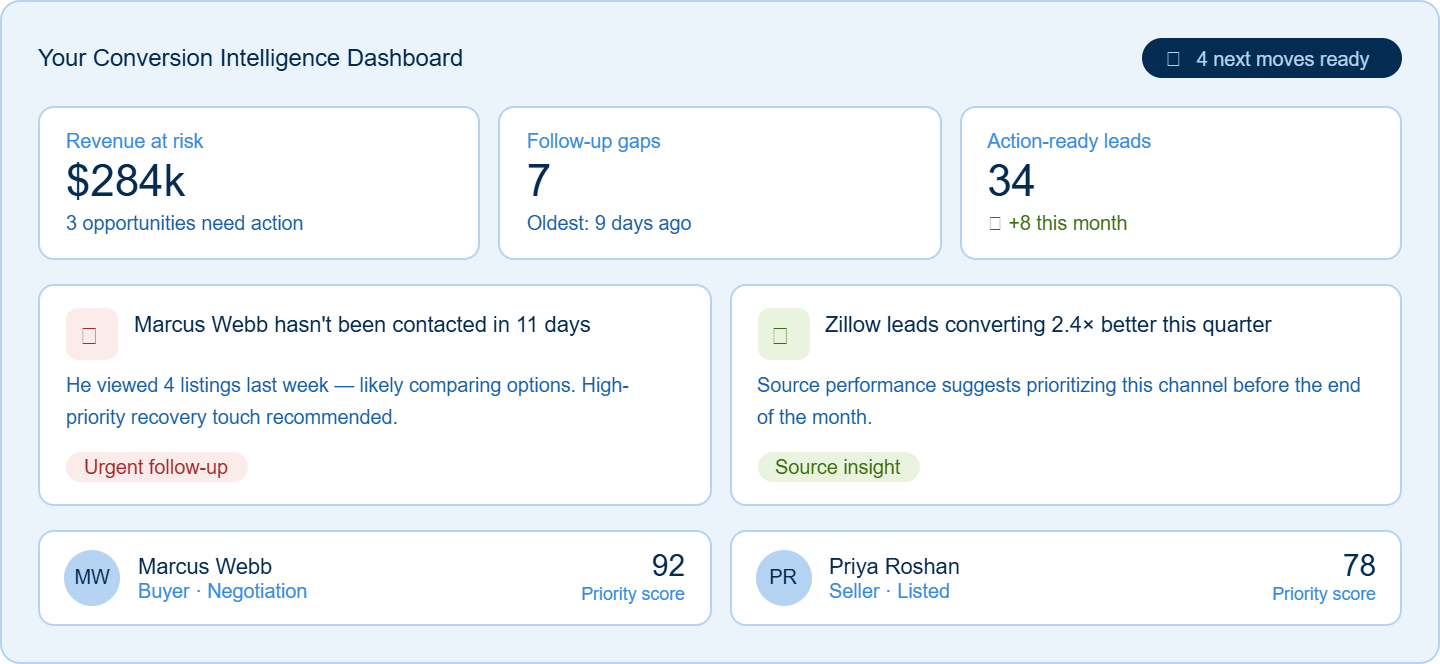
    Conversion Realtor turns changing lead signals into a ranked execution plan. Agents see who needs attention, the next best move, recommended messaging, timing, and the reasoning behind the recommendation.

    Who to work
    What to say
    When to act
    Why it converts

    Learn more about conversion intelligence for real estate leads, how Conversion Realtor works, how Conversion Intelligence works, or pricing.

    Real estate lead conversion dashboard ranking opportunities and recommended next actions

    Real Estate Lead Conversion FAQs

    Turn Every Lead Into a Clear Next Move

    Stop guessing which lead to contact or what to say next. Analyze a real buyer or seller conversation and see the intent, urgency, objections, timing, psychology, and recommended next action.

    No credit card required · Up to 3 real leads free