Technology
The Real Estate Conversion Rate Crisis: Why 95% of Agents Are Losing Deals They Already Have
Real Estate Lead Conversion and How Crucial the Percentages are and How to Fix Them
Christopher McCurdy
Updated
5 min read
By Christopher McCurdy, Founder of Conversion Realtor
The national real estate lead conversion rate has sat between 0.4% and 1.2% for over a decade.
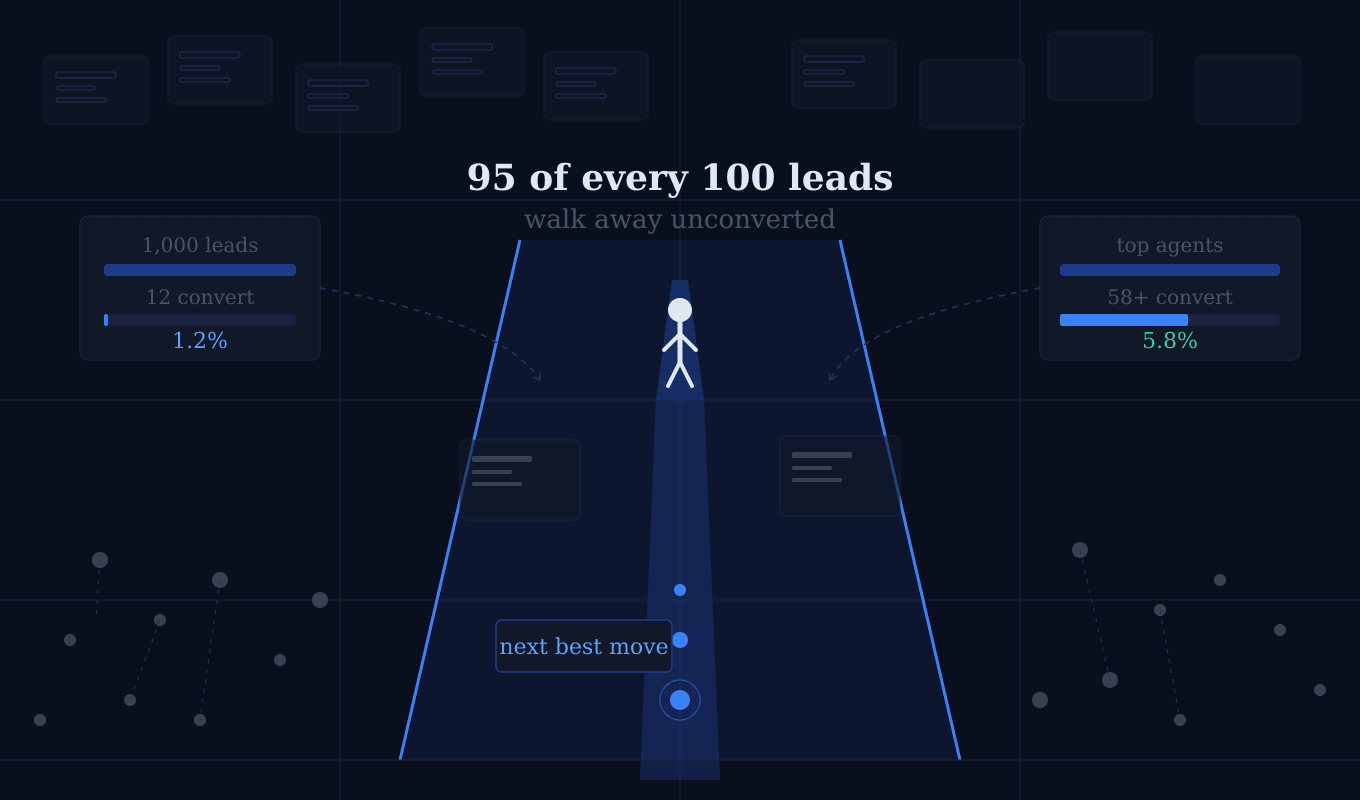
Let that sink in. For every 1,000 leads a real estate agent receives, fewer than 12 become closed transactions. Most agents are working harder than ever — buying more leads, adding more tools, running more follow-up sequences — and the number barely moves.
Conventional wisdom says this is a volume problem. Buy more leads, close more deals. But the data tells a completely different story.
The conversion crisis in real estate is not a lead problem. It is a decision problem.
The Numbers Every Agent Should Know
Before diagnosing the cause, the data needs to be clear.
The National Association of Realtors reports the average agent conversion rate sits between 0.5% and 1.2% — meaning roughly 1 to 2 clients for every 200 leads captured. Raw internet leads from platforms like Zillow and Realtor.com perform even lower, often converting at 0.4% to 1.2% from inquiry to closed transaction.
Top-performing agents tell a different story. Agents in the top 10% for lead conversion achieve rates approximately three times higher than the industry average, according to Zillow Group's agent performance research. The top 1% of agents — those responding within minutes and following a structured decision process — see lead-to-client conversion rates of 5% to 6%, with lead-to-appointment rates near 28%.
The gap between average and elite is not 10% or 20%. It is 400% to 600%.
That gap has persisted for over a decade despite the rise of CRMs, marketing automation platforms, and AI-generated content tools. Technology has improved organization and activity. It has not materially improved decision quality — and decision quality is what separates a 1.2% converter from a 5.8% converter.
The Speed Myth (and the Bigger Truth Behind It)
When conversion rates come up, speed to lead is always the first answer offered.
The data supports the urgency. Inman's 2025 Real Estate Technology Survey found the average agent takes 917 minutes — over 15 hours — to respond to a new lead inquiry. Research from Real Trends and InsideSales.com shows agents who respond within 5 minutes are 21 times more likely to qualify a lead than those who wait 30 minutes. NAR's 2025 Home Buyers and Sellers Generational Trends Report found that 78% of homebuyers end up working with the first agent who responds.
Speed matters. No serious practitioner disputes this.
But speed alone does not explain the conversion gap. If it did, every agent with an automated instant response would be closing at 5%. They are not.
Here is what the data shows when you look more carefully: the top 1% of converting agents respond fast and they know exactly what to say when they do. Their follow-up is not generic. Their messaging is calibrated to the specific signal the lead sent — the urgency level, the concern behind the inquiry, the psychological stage the buyer or seller is in.
Speed gets you into the conversation. Decision quality determines whether you win it.
The Five Moments Where Deals Actually Die
In researching the conversion gap, a pattern emerges consistently across the data. Deals do not die in the obvious places — the price negotiation, the final offer, the inspection. They die in micro-moments. Specific decision points where the agent either knows the right move or freezes.
1. Follow-Up Timing
Waiting too long to follow up after initial contact. The lead's intent peaks at the moment of inquiry and declines rapidly. Every hour of delay is compounding conversion loss.
2. Buyer Persona Mismatch
Using the wrong tone for the wrong buyer or seller. An investor requires raw ROI data and efficiency. A first-time buyer needs education and reassurance. A luxury seller expects exclusivity and discretion. Generic messaging sent to all three performs for none of them.
3. Lead Urgency Misjudgment
Misreading when a lead is ready to act. Treating a high-urgency signal as a casual inquiry — or vice versa — either loses the deal to a faster competitor or pushes a hesitant buyer away with pressure they are not ready for.
4. Objection Signal Blindness
Missing early resistance signals in conversations. A lead who says "we're still thinking about it" and a lead who says "prices feel a little high" are sending completely different signals. Agents who cannot distinguish between them respond generically and lose both.
5. Lead Context Collapse
Treating every lead the same regardless of source, behavior, or history. A Zillow inquiry from someone who viewed a listing three times in two days is not the same lead as someone who submitted a general contact form once. The same message sent to both leaves conversion on the table.
Most deals are not lost because agents lack effort. They are lost in the pause between knowing and acting — the moment when the right move is not obvious and the agent either freezes or defaults to a generic response.
What Elite Converters Do Differently
The research on top-performing converters converges on three behaviors that separate the top 1% from the rest.
They treat every lead interaction as a revenue decision, not a task.
Average agents see follow-up as an activity to complete. Elite converters see it as a decision to make: what is the highest-probability move for this specific lead at this specific moment? That reframe changes everything about how they approach their pipeline.
They match messaging to psychology, not just timing.
The best follow-up is not the fastest follow-up — it is the most relevant follow-up. A price-sensitive buyer who gets a message addressing their budget concern before they even voice it experiences something that feels less like sales and more like understanding. That psychological match is what converts hesitation into action.
They use behavioral signals, not just demographic data.
What a lead does reveals far more than what they say. Viewing a listing multiple times signals commitment. Submitting an inquiry at 11pm signals urgency. Engaging with market report content signals a seller in research mode. Elite converters read these behavioral signals and calibrate their response accordingly. Most agents never look at them at all.
The ROI Case for Conversion Over Volume
Here is the financial argument that rarely gets made clearly.
If you receive 100 leads per month and close at the industry average of 1.2%, you close 1.2 deals per month. At an average commission of $10,000, that is $12,000 in monthly revenue.
If your conversion rate improves to 3% — still well below elite performance — you close 3 deals per month from the same 100 leads. That is $30,000 in monthly revenue. A 150% revenue increase with zero additional lead spend.
Now consider that most agents are currently spending $20 to $500 per lead depending on source. At 100 leads per month, that is $2,000 to $50,000 in monthly lead acquisition cost. Doubling your conversion rate is the equivalent of cutting your cost per acquisition in half — without negotiating a single rate or switching a single lead source.
This is why conversion rate is the highest-leverage metric in real estate. It multiplies the value of every dollar already being spent.
Why the Technology Gap Has Persisted
It would be reasonable to ask: with all the CRM technology, AI tools, and automation platforms available today, why has the industry conversion rate barely moved in a decade?
The answer is that most technology optimizes for the wrong thing.
CRMs store data and track activity. They tell you that you called a lead on Tuesday. They do not tell you what to say when you call again on Thursday.
Automation platforms execute sequences. They ensure your drip campaign sends on schedule. They do not adjust the message based on what the lead did since the last email.
AI content tools generate copy faster. They produce listing descriptions and social posts in seconds. They do not know whether the lead they are being used to reach is a first-time buyer with price anxiety or an investor who needs cap rate data.
All of these tools improve efficiency. None of them improve judgment.
The missing layer in the real estate technology stack is decision intelligence — a system that actively analyzes the behavioral signals, psychological context, and timing factors for each lead and surfaces the single highest-probability action for that specific moment. Not a list of tasks. Not a generic sequence. One clear move, calibrated to one specific lead, at the exact right moment.
That is the gap the data has been pointing to for a decade. The conversion crisis is not a lead shortage. It is a decision shortage.
What Agents Should Do Right Now
Three immediate changes any agent can make based on the data:
1. Audit your response time. If you are responding to leads in hours rather than minutes, that single change — getting to under 5 minutes for initial contact — can improve your contact rate dramatically. The data on this is unambiguous.
2. Segment your leads by behavioral signal, not just source. Before your next follow-up, ask: what did this lead actually do? How many times did they view the listing? What time did they inquire? What did they say, and what is the concern behind what they said? That 60-second audit before each call changes the quality of every conversation.
3. Stop measuring activity. Start measuring decision quality. How many calls you made is an activity metric. Whether the right call happened at the right moment with the right message is a decision metric. The agents closing at 5% are not making more calls. They are making better decisions about which calls to make.
4. The national conversion rate will not improve on its own. It has not in ten years. But for the individual agent willing to treat conversion as a decision science rather than a volume game, the opportunity is significant — and it starts with the leads already in your pipeline.
---
Christopher McCurdy is the founder of Conversion Realtor, a Conversion Intelligence platform that uses the DRIFT Model™ — a proprietary behavioral framework — to surface the next best action for every real estate lead based on psychology, timing, and intent. Learn more at conversionrealtor.com.
---
Sources referenced:
- National Association of Realtors, 2025 Home Buyers and Sellers Generational Trends Report
- Inman Real Estate Technology Survey, 2025
- Real Trends / InsideSales.com Lead Response Study, 2025
- Zillow Group Agent Performance Research
- MIT/InsideSales.com Lead Response Management Study
- LeadSimple Research, First Responder Advantage Study
Related Articles
Technology
Real Estate Conversion Intelligence: Why Spending More on Leads Isn’t the Answer
Conversation about real estae lead cost and the solution for higher conversion and more sales
Technology
Why Real Estate Conversion Intelligence Systems Are the Future of Lead Conversion
CRM & AI VS Real Estate Conversion Intelligence Systems
Technology
The Shift From Individual Effort to Repeatable Systems in Real Estate
Explore the transition from individual effort to systematic approaches in real estate lead conversion.
Subscribe to Our Blog
Subscribe to receive new blog posts from Conversion Realtor directly in your inbox.
No spam. Unsubscribe anytime.
This article is part of our real estate conversion intelligence framework — the discipline of making better decisions at every stage of a real estate transaction. See how it applies to lead follow-up and other critical decision moments.