The DFW Housing Market Is Shifting — Here’s What That Actually Means
Rising interest rates have shifted the Dallas–Fort Worth housing market from rapid pandemic-era growth into a period of recalibration. This article breaks down how higher borrowing costs are affecting home prices, inventory, buyer behavior, rental demand, and what the outlook looks like heading into 2026—highlighting why DFW remains more resilient than many U.S. markets despite the slowdown.
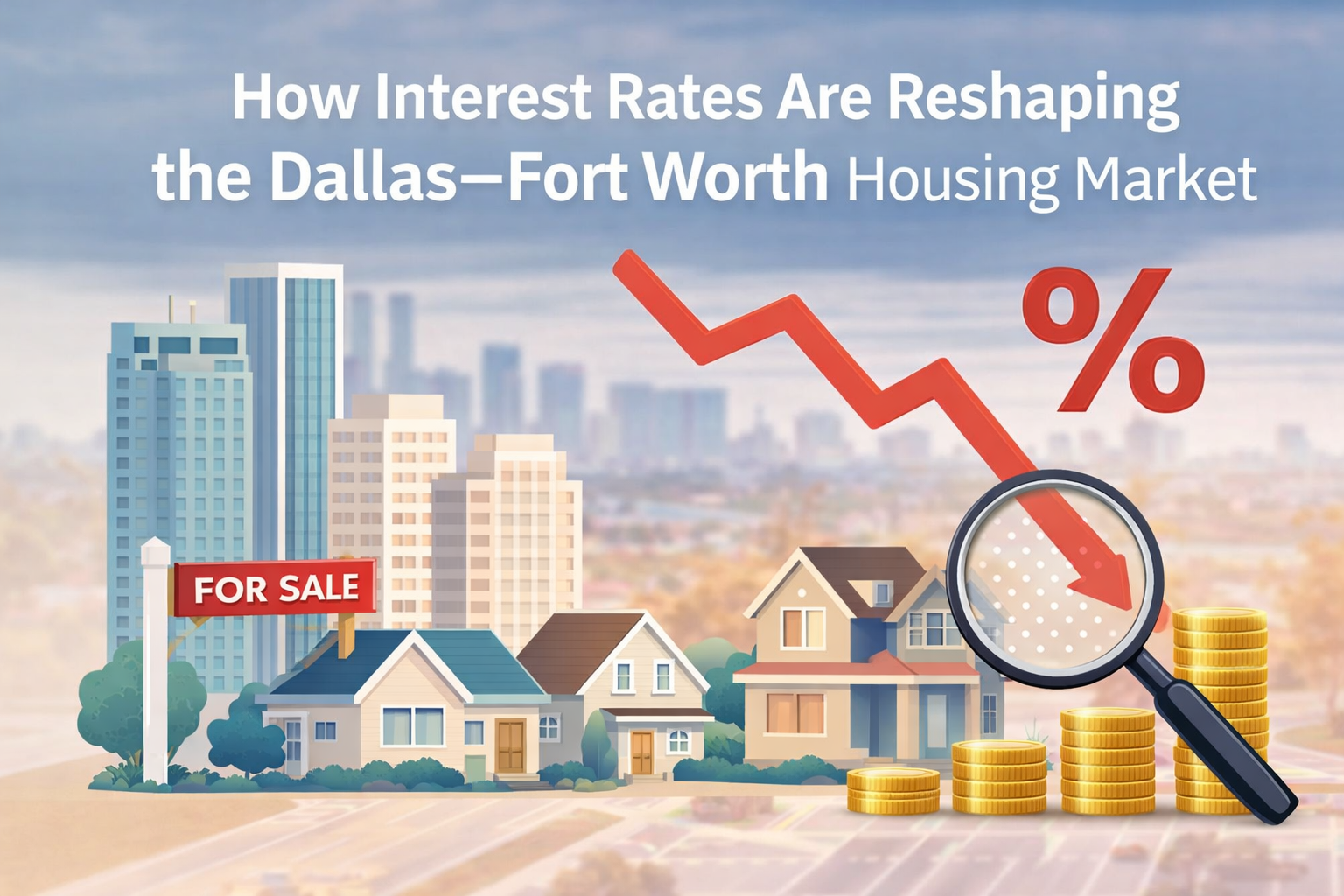
How Interest Rate Trends Are Reshaping the Dallas–Fort Worth Market
A Clear Cooldown After Years of Acceleration
After an extended run of rapid appreciation, higher borrowing costs have pushed the market into a reset phase. Median home prices across North Texas declined 5.3% year over year by late 2025, signaling a move toward price normalization rather than continued escalation.
Homes are also taking longer to sell. Median days on market rose 23.1% in 2025, reflecting a shift away from the hyper-competitive conditions of the pandemic years. At the same time, elevated mortgage rates have dampened buyer activity, contributing to a meaningful pullback in closed sales across major DFW counties—including a 17% decline in Dallas County.
The Lock-In Effect Meets Rising Inventory
While many homeowners remain reluctant to give up sub-4% mortgages, inventory levels have still increased, easing the urgency that once defined the market and giving buyers more leverage than they’ve had in years.
Builders have responded by adjusting their strategies. New construction is increasingly focused on affordability, with a growing share of new homes now priced below $250,000, reflecting both buyer constraints and a recalibration of demand.
Diverging Outcomes for Buyers and Renters
Affordability pressures have widened significantly. Over the past five years, average mortgage payments have risen roughly 82%, while household incomes increased by only 26%, creating a substantial gap for many would-be buyers.
First-time and moderate-income buyers have been hit hardest, leading to more entry-level inventory lingering on the market. Meanwhile, higher barriers to ownership are reinforcing rental demand, with rents expected to rise 5–7% as more households remain on the sidelines.
A Market Defined by Segmentation
Not all price tiers are responding the same way. The luxury segment ($1M+) in Dallas has shown notable resilience, buoyed largely by cash buyers and long-term equity holders. In fact, luxury transactions increased 14% between 2024 and 2025, defying broader market trends.
Suburban markets such as Frisco, McKinney, and Rockwall continue to attract families drawn to schools, space, and amenities, though these areas are also experiencing the effects of affordability constraints and price sensitivity.
Looking Ahead to 2026
The outlook points to gradual stabilization rather than a sharp rebound. Mortgage rates are expected to remain in the low-to-mid 6% range, with some projections suggesting a dip below 6% by late 2026—potentially reigniting activity during the spring season.
After the correction seen in 2025, pricing is forecast to level out, with modest growth below 2% as the market adapts to a higher-rate environment that is increasingly viewed as the new normal.
Bottom Line
Despite ongoing challenges, Dallas–Fort Worth continues to show greater resilience than many U.S. metros. Sustained job growth, corporate relocations, and steady population inflows are helping cushion the impact of higher rates, positioning the region for a more balanced—and ultimately healthier—housing market cycle.
Related Articles
The Real Estate Market Has Changed Faster Than Agent Behavior
Real estate professionals are operating in a market that moves faster, demands more responsiveness, and punishes hesitation more than ever before.
Subscribe to Our Blog
Subscribe to receive new blog posts from Conversion Realtor directly in your inbox.
No spam. Unsubscribe anytime.
This article is part of our real estate conversion intelligence framework — the discipline of making better decisions at every stage of a real estate transaction. See how it applies to lead follow-up and other critical decision moments.